
What you see is not reality itself
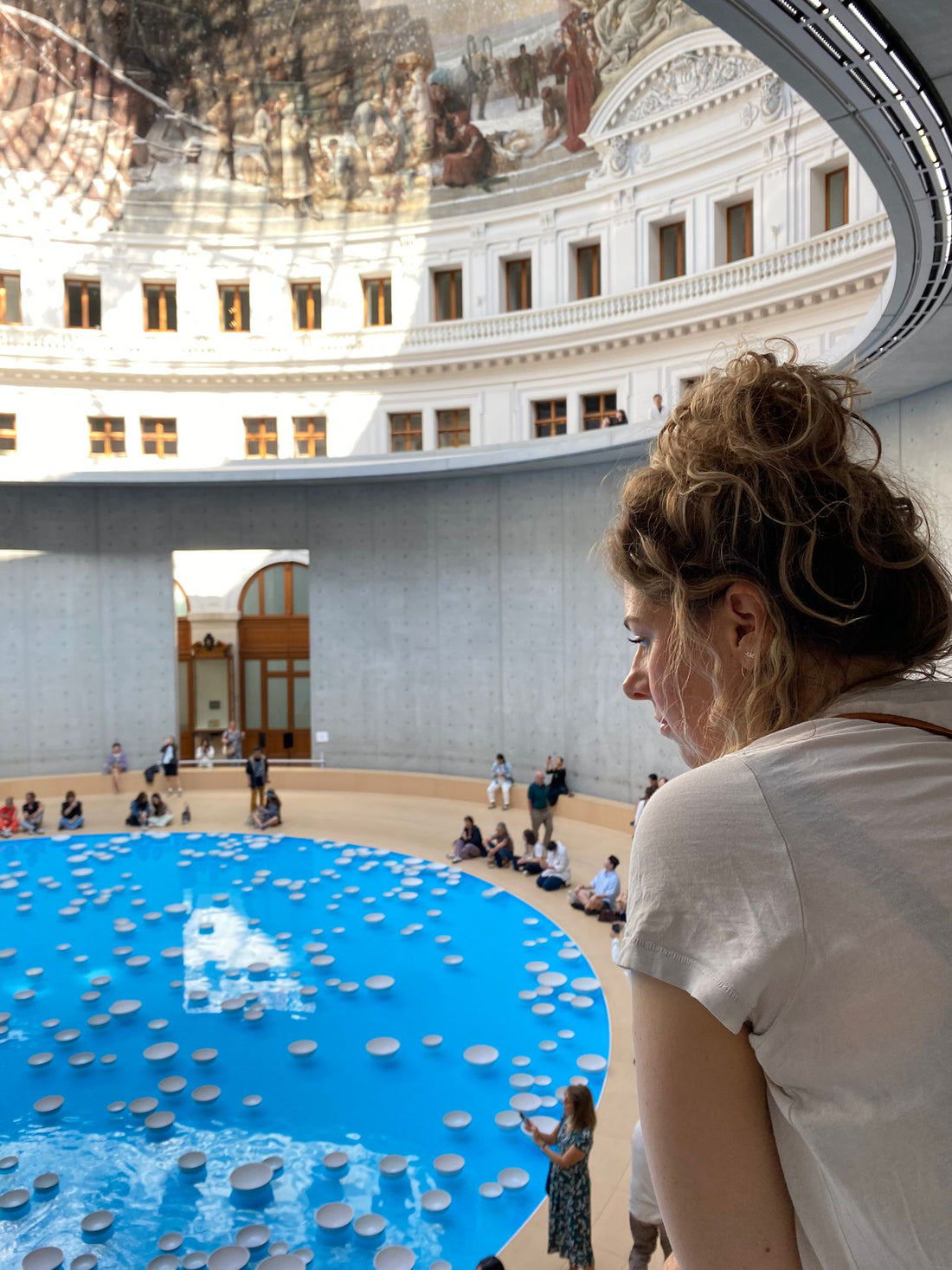
The space is large, high, and round. The basin is unmistakably blue. White bowls float slowly around. The moment they touch, a clear, singular sound resounds. All the sounds together form an ever-changing piece of music.

Clear language
Céleste Boursier-Mougenot's installation "Clinamen" enchants me, my sister, and everyone present. I think it's the clarity of the language. The rounded shapes of the space, the basin, and the bowls. The white and the blue, the pure sounds. Nothing else. That simplicity creates space for your own thoughts.
Clinamen comes from Latin and refers to the slight, random deviation in the motion of atoms (a concept coined by the Roman philosopher Lucretius). Boursier-Mougenot uses this idea to demonstrate how chance can create beauty and order.
No objective world
As I sat cross-legged by this water, my thoughts wandered around the themes of consciousness, perception, and reality. And how that plays a role in shaping your own ibasho : the place where you can be completely yourself.
I thought about how you don't simply perceive an objective, existing world, but actively create your experience with your body and brain. I was reminded of Bernardo Kastrup's theory of consciousness: that the way we perceive the world is similar to how a pilot forms an image of their surroundings through the dashboard. And also of what I've learned recently about the senses, sensory processing, and emotions, both in my studies and through the work of Lisa Feldman Barrett.
Your brain translates
What you see isn't reality itself, but what your senses and brain make of it. A pilot relies on the instruments in their cockpit because they provide the best possible translation of what's happening outside. We rely on our brain, which combines sound waves, light waves, chemical signals, and the forces exerted by molecules on our skin with previous experiences, context, and expectations, and translates them into something we can understand and use.
Not one fixed experience
In the book "The Seven Senses" by Iris Sommer, I read: "We perceive the world around us through our senses. How we see, hear, feel, taste, and smell determines our view of the world. Conversely, our view of the world also determines what we perceive."
I feel that here too. This artwork is meant to invite slowing down and stillness. But someone who feels rushed or easily overstimulated might experience it as restless or chaotic.
For me, it shows that a space, like this artwork, doesn't offer a single, fixed experience, but rather a playing field within which everyone creates their own reality. That's why it's so important to tailor living environments to the senses, minds, and needs of the people who live or work there.
Connectedness
Clinamen also made me realize that connection goes beyond being in a room together. It's about experiencing a shared, unique, one-off moment that will never come again, in which you co-create reality by consciously experiencing it with your body and mind.
What this artwork teaches me about spatial design
If you want to design an ibasho, a place where you can be your authentic self, you have to go beyond a pretty picture. Deeper. The experience I had with this artwork helped me understand this a little better.
At the heart of every spatial design is the human being . The human being with a brain that works in a certain way, with senses that are sharp or less sharp, with a history, memories, associations, dreams, and preferences.
Based on all these factors, each person shapes their own experience of the space and the moment. The environment plays a role, but not the all-important one. For example, the same space can be "felt" completely differently by different people. When designing an ibasho, you don't start with the environment (the picture), but with the person, or people, who live in it. In this way, layer by layer, you develop a design that is not only beautiful but also resonates with the people who will live there.