
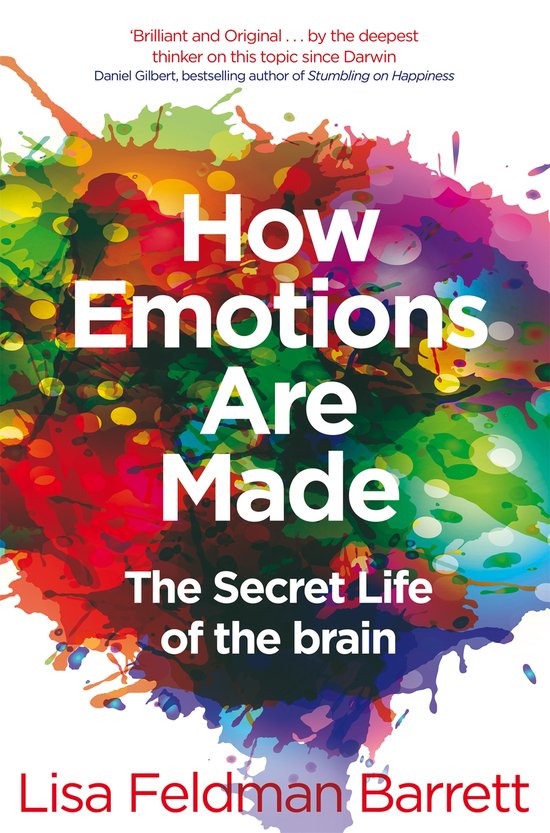
Read this book! 'How emotions are made'
Over the past few days, I've been reading Lisa Feldman Barrett's book "How Emotions Are Made," along with her other book, "Seven and a Half Lessons About the Brain." The book is an important foundation for my IBASHO model, which I developed to discover what your body, senses, and brain need in a living space in four steps.
Lisa Feldman Barrett
Lisa Feldman Barrett is a Canadian-American neuroscientist and professor of psychology. She has numerous publications and awards to her name. She is best known for her work on how emotions are constructed in our brains. I'm interested not only in her theory of emotions but also in her underlying explanation of how the brain works. A fundamental feeling in our bodies plays a role even deeper than emotions: affect.
What is affect?
You always feel affect. It's a basic feeling, not yet an emotion. It lies somewhere along the dimensions of pleasant-unpleasant and high-low energy level (or 'arousal,' as it's called in English).
That affect doesn't just happen. According to Feldman Barrett, it's a result of the brain making predictions and interpreting signals from the body. It's a kind of summary of all the information you receive through one of your sensory systems: the interoceptive system.
The interoceptive system
This sense is less well-known than, for example, hearing and sight, but it's incredibly important for your body. Through this system, your brain receives information about everything happening in your body, from your heart rate and blood pressure, to your hormone and blood sugar levels, to whether you need to pee and whether you're hot or cold.
As humans, we're not designed to individually experience what's happening in each organ. Have you ever felt your kidneys busy purifying your blood, for example? That's why this system summarizes your body's state as affect . This can make you grumpy when you're hungry, or miserable because you actually have cold feet.
Affect and ibasho
Interesting information, right? If you're serious about designing your own ibasho, a place where you can truly be yourself and feel completely at ease, then it's a logical next step to explore how we can positively influence that affect in our bodies.
Now you might be thinking: simple enough. You make sure you're well-fed, your temperature is right, and your body sends the signal "everything's okay" to your brain. A positive affect, everything's fine.
But it's not that simple. While affect is indeed based on signals from your body, what your body does depends on much more than whether you've eaten well or not. Your brain is involved in infinitely more.
Your brain predicts
Your brain's primary goal is to keep you alive. So, it uses all the information from previous experiences, your body, and your environment to make predictions. Is it safe here? What's about to happen? Should I take action, stay alert, hide, or attack? Based on these predictions, your brain rapidly allocates your "body budget." This is another Feldman-Barrett term, referring to energy, blood sugar, blood flow, muscle tension, and everything else needed to maintain your basic functions in balance.
And when you predict, your brain doesn't wait to see if the prediction is accurate. No, your body immediately puts everything in place to respond appropriately.
An example
Perhaps you've experienced it before: you're walking through the living room at night and suddenly see your own reflection in the window. Before you realize it's just you, your body has already taken action: adrenaline pumps through your body, your muscles tense, and your heart rate triples. In these situations, I even feel my armpits stinging because I instantly break out in sweat.
What happened? Your brain probably predicted, based on previous experiences, that you should be more vigilant in the dark. Stories about burglars, scary movies, or things you've personally experienced in the dark all played a role. As soon as you saw your reflection, your brain predicted: danger! It told your body to prepare for attack or escape by increasing your heart rate, releasing adrenaline, and tensing your muscles.
But what if the prediction is wrong? Your brain uses the input from your senses to adjust its predictions. Your body calms down again (after a while) once the visual input from your reflection has been fully processed and you understand that it's you, not a dangerous burglar.
Designing a living space
Let's return to designing a living space. In my model, your body and brain are central, and we focus on affect : the basic physical sensation that indicates whether you feel comfortable or not. The goal is to design the space in such a way that your affect is positively influenced, so that your brain ultimately generates positive emotions such as calmness, happiness, and a sense of belonging.
In an ibasho, you want to generate affect that supports comfort, safety, and relaxation. This means a pleasant feeling, low to moderate arousal, and a balanced body budget . This baseline feeling makes it easier for your brain to later construct emotions like contentment, relaxation, or happiness.
How do we approach this? My IBASHO model contains four pillars to help you do this. These pillars align with existing theories on safety, healing environments, and interior design.
Next time I'll tell you exactly how the model is put together!